
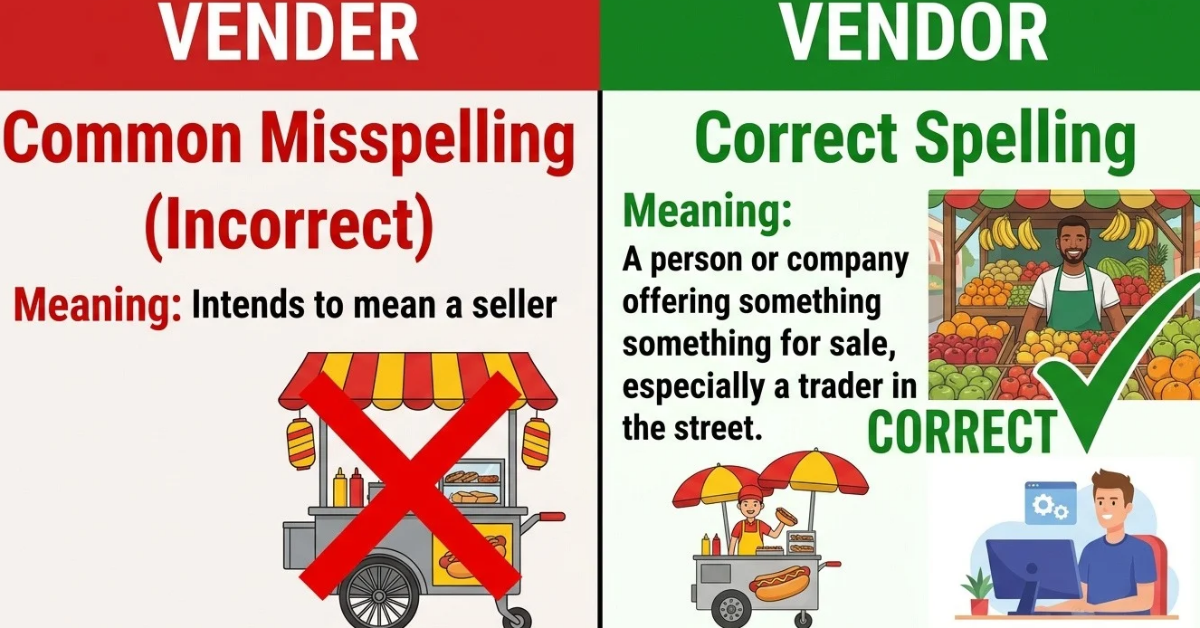
Have you ever written an email, prepared a business document, or searched for a supplier and wondered whether to write vender or vendor? These two words look almost identical, but only one is commonly used in modern English to describe a person or business that sells goods or services.
The correct spelling for a seller is vendor. You will see this word in business contracts, online marketplaces, shopping websites, and everyday conversations about buying and selling. Although vender appears in some dictionaries as a variant spelling of vendor, it is much less common and is generally best avoided in professional writing.
In this guide, we will explore the difference between vender and vendor, explain their meanings, provide practical examples, and answer common questions to help you choose the right word with confidence.
Vender or Vendor: Which One Is Correct?
The answer depends on how the word is being used, but in most situations, vendor is the preferred spelling.
A vendor is a person, company, or organization that sells products or services to customers or other businesses. For example, a company that supplies office furniture, a person selling fruit at a market, or a business providing website hosting can all be described as vendors.
Here is a quick comparison:
| Word | Meaning and usage |
|---|---|
| Vendor | The standard, widely accepted spelling for a seller or supplier. |
| Vender | A less common spelling variant of vendor; generally avoided in formal and professional writing. |
If you are writing a business proposal, preparing an invoice, creating website content, or communicating with a supplier, choose vendor. It is the spelling most readers will expect.
What Does Vendor Mean?
A vendor is an individual or business that sells goods or services. The term is widely used in commerce, retail, technology, event planning, and real estate. According to the Cambridge Dictionary, a vendor can be someone selling products directly to customers or a company supplying products to other businesses.
For example, imagine you own a small clothing store. The company supplying your dresses, shirts, and accessories is one of your vendors. If you buy a laptop from a computer shop, that shop can also be called a vendor.
The word can describe different types of sellers, including:
-
Retail vendors: Businesses that sell products directly to consumers.
-
Street vendors: People who sell food, drinks, or other goods from stalls, carts, or public spaces.
-
Wholesale vendors: Suppliers that sell goods in bulk to retailers or other businesses.
-
Software vendors: Companies that develop or sell software products.
-
Service vendors: Businesses that provide services such as cleaning, maintenance, or IT support.
-
Event vendors: Businesses that supply catering, flowers, decorations, photography, or equipment for events.
The exact meaning depends on the context, but the central idea remains the same: a vendor is someone who sells something.
What Does Vender Mean?
Vender is a recognized spelling variant of vendor. It is listed in some English dictionaries, including Collins Dictionary and Dictionary.com.
Although the spelling is not necessarily incorrect, it is considerably less familiar to many modern readers. In everyday business communication, vendor is the safer choice because it is widely recognized and commonly used.
Consider these examples:
-
Less common: “We contacted a local vender for the supplies.”
-
Preferred: “We contacted a local vendor for the supplies.”
Both versions communicate the same idea, but the second is more suitable for most professional settings.
A useful rule: When referring to a seller, use vendor unless you have a specific reason to follow a source or style guide that uses vender.
Why Do People Confuse Vender and Vendor?
The confusion is understandable. The two spellings differ by just one letter, and both are associated with the verb vend, which means to sell.
There are several reasons people mix them up.
1. Similar pronunciation
In common English pronunciation, vender and vendor sound very similar. In many accents, they may sound identical or nearly identical, so listening alone may not help you identify the preferred spelling.
2. Familiar spelling patterns
English uses both -er and -or endings to form nouns referring to people or things associated with an action. For example, we write teacher but actor. Because both endings are familiar, it is easy to second-guess which one belongs in vendor.
3. Dictionary variations
Some dictionaries explicitly recognize vender as an alternative spelling. This can make people wonder whether one version is American English and the other is British English.
However, it is not quite that simple. The standard word vendor is widely used in both American and British English, while vender is an accepted variant in some references and contexts.
4. Typing and autocorrect mistakes
Since the words are so similar, typing quickly can lead to spelling errors. Autocorrect may not always flag vender because it is a recognized word.
If you regularly write emails, product descriptions, reports, or website articles, using vendor consistently helps keep your writing clear and professional.
Vendor vs. Supplier vs. Seller: What’s the Difference?
These terms are related, but they are not always interchangeable in every business situation. Understanding their differences can help you choose the right word for emails, contracts, and other professional documents.
| Term | Meaning | Example |
|---|---|---|
| Vendor | A person or business selling goods or services. | A company selling office computers. |
| Supplier | A person or business providing goods, materials, or services. | A company supplying fabric to a clothing manufacturer. |
| Seller | A general term for someone offering something for sale. | A person selling a used phone. |
| Distributor | A business that distributes products from manufacturers to retailers or other buyers. | A company supplying packaged products to stores. |
| Manufacturer | A business that makes products. | A factory producing furniture. |
These roles can overlap. For example, a furniture manufacturer may sell directly to customers and therefore act as a vendor, while a distributor may also be a vendor to the stores it supplies. Business terminology can vary by industry and organization.
How to Use Vendor Correctly in a Sentence
The easiest way to understand a word is to see how people use it in everyday situations. Here are several examples of vendor in different contexts.
1. Business and office communication
-
“We need to contact the vendor about the delayed shipment.”
-
“Our company works with several international vendors.”
-
“Please send the invoice to the vendor management team.”
2. Shopping and retail
-
“The market vendor sells fresh vegetables every morning.”
-
“I found a reliable vendor for affordable home accessories.”
-
“The online vendor offers free delivery on selected products.”
3. Technology and software
-
“The company selected a new software vendor.”
-
“Our IT team is discussing the issue with the hardware vendor.”
-
“The vendor released an update to improve system performance.”
4. Events and services
-
“We booked a catering vendor for the wedding.”
-
“The event organizer contacted the decoration vendor.”
-
“Several local vendors participated in the exhibition.”
Notice how vendor works naturally in each sentence. It identifies the person or business providing the product or service.
Common Vendor Spelling Mistakes to Avoid
Even confident English writers sometimes make mistakes with words that have similar spellings. If you want your writing to look polished, watch out for these common errors.
-
Writing vender in formal business documents: Although it is a recognized variant, vendor is the more widely preferred choice.
-
Confusing a vendor with a buyer: A vendor sells; a buyer purchases.
-
Assuming every vendor is a company: An individual selling handmade products or food can also be a vendor.
-
Using vendor and supplier as if they always mean different things: Their meanings overlap, and the distinction depends on the context.
-
Using inconsistent spelling: Choose vendor and use it consistently throughout your article, report, or business correspondence.
A simple memory trick
Think of the word vendor as the standard spelling you see in phrases such as vendor agreement, vendor list, vendor payment, and vendor management.
Remembering these common business expressions makes the correct spelling easier to recall.
Why Vendor Is Important in Business
A vendor is more than just someone who sells a product. Vendors can play an important role in helping businesses operate smoothly, manage expenses, and serve their customers.
Here are some of the ways vendors contribute to business operations.
-
Providing essential products: Businesses rely on vendors for equipment, inventory, office supplies, and other resources.
-
Delivering specialized services: External companies may provide software, maintenance, marketing, or technical support.
-
Supporting daily operations: Reliable vendors help businesses obtain the goods and services they need on time.
-
Managing costs: Comparing vendors can help organizations find suitable pricing and purchasing terms.
-
Building business relationships: Good communication with vendors can improve service quality and help resolve problems more efficiently.
For these reasons, companies often maintain vendor records, review invoices, compare quotations, and monitor vendor performance. Choosing a suitable vendor can make a meaningful difference to the cost and reliability of business operations.
Frequently Asked Questions (FAQs)
1. Is it vender or vendor?
Vendor is the preferred spelling in modern English. Vender is also recorded as a variant spelling, but vendor is the safer choice for most professional and everyday writing.
2. Is vender a real word?
Yes. Some dictionaries recognize vender as an alternative spelling of vendor. It means a person or business that sells something, although it is less commonly used.
3. What does vendor mean in simple words?
A vendor is someone who sells goods or services. For example, a person selling snacks at a street stall or a company selling computers to offices can be called a vendor.
4. Is a vendor a buyer or a seller?
A vendor is a seller. The buyer is the person or business that purchases the goods or services.
5. What is the plural of vendor?
The plural of vendor is vendors.
Example: “The company reviewed proposals from five different vendors.”
6. Is vendor an American or British English word?
Vendor is used in both American and British English. Some dictionaries also recognize vender as a variant, including in American English and certain British legal contexts.
7. What is a vendor in business?
In business, a vendor is a person or organization that sells products or services to consumers or other businesses. Examples include office supply companies, software providers, catering businesses, and equipment sellers.
8. What is the difference between a vendor and a supplier?
A vendor is generally someone who sells goods or services. A supplier often refers to a business that provides materials, components, or products to another business. However, the terms are frequently used interchangeably, depending on the industry.
9. How do you pronounce vendor?
In American English, vendor is commonly pronounced VEN-der. The first syllable is stressed, and the word sounds very similar to vender.
10. Should I use vender or vendor in an SEO article?
Use vendor as your primary keyword when writing about sellers, suppliers, or business services. You can mention vender or vendor naturally in the title, introduction, and FAQ section to address the spelling question without repeating the phrase excessively.
Conclusion
When deciding between vender or vendor, remember that vendor is the standard, widely preferred spelling for a person or business that sells goods or services. Although vender appears in some dictionaries as an alternative, it is less familiar to many readers.
Understanding the word’s meaning also helps you use it correctly in business emails, online shopping, professional documents, and everyday conversations. Whether you are referring to a street seller, a software company, or an event service provider, vendor is usually the best choice.
If you are improving your English vocabulary or creating professional content, keep this spelling in mind and explore related guides on commonly confused English words to strengthen your writing skills.
