
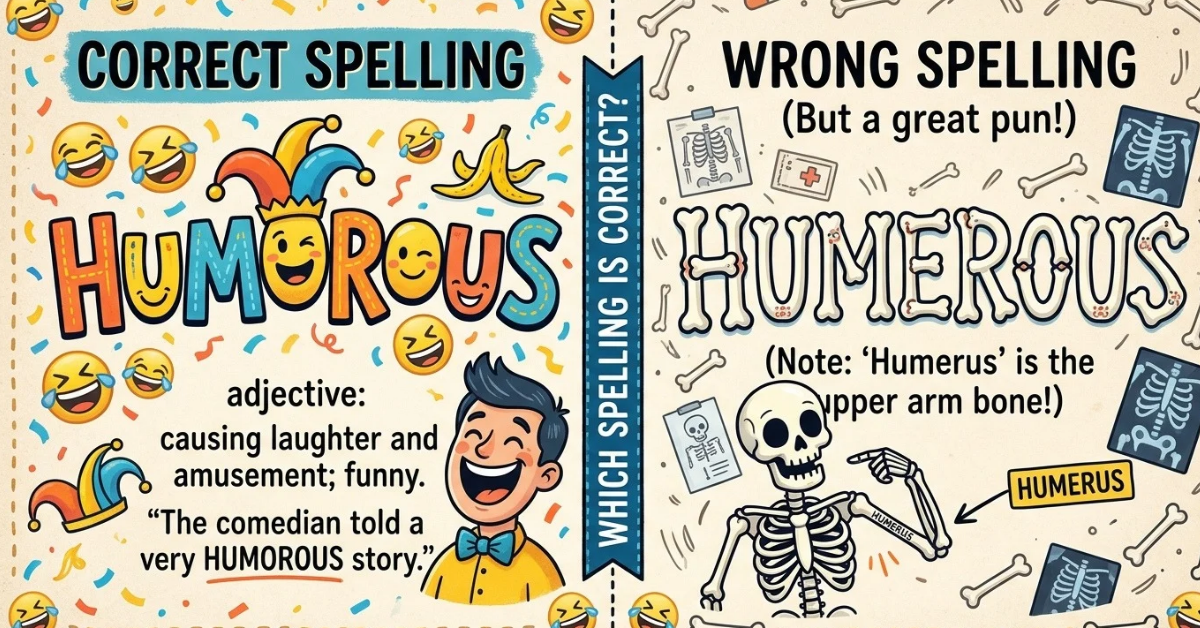
Have you ever written a funny comment, a social media caption, or a sentence about someone who makes everyone laugh, only to wonder whether humorous or humerous is the correct spelling? It is an easy mistake to make because the two words look almost identical. However, only one is the standard spelling of the word that means funny or amusing.
When comparing humorous vs humerous, the correct choice is humorous. It describes something that makes people laugh or feel entertained. Humerous, on the other hand, is a common spelling error and is not accepted as a standard English word with that meaning.
In this guide, we will explain the difference, explore example sentences, discuss pronunciation, and share practical tips to help you remember the correct spelling.
Humorous vs Humerous: Which Spelling Is Correct?
The difference between these two spellings is simple: humorous is correct, while humerous is a misspelling when you want to describe something funny.
Although humerous may look reasonable, it is not the standard form recognized by mainstream English dictionaries for this meaning. The confusion often happens because English pronunciation does not always make spelling differences obvious.
Here is a quick comparison:
| Word | Status | Meaning |
|---|---|---|
| Humorous | Correct spelling | Funny, amusing, or entertaining |
| Humerous | Incorrect spelling | A common misspelling of humorous |
For example, if your friend tells a joke that makes everyone laugh, you could say, “That was a humorous story.” Writing “That was a humerous story” would be a spelling mistake.
The key takeaway is straightforward: whenever you mean funny or amusing, use humorous.
What Does Humorous Mean?
The adjective humorous describes a person, remark, story, situation, or piece of writing that contains humor or makes people laugh. It can refer to anything from a playful comment to a clever comedy sketch.
According to standard English usage, something humorous does not necessarily have to make everyone burst into laughter. It might simply be witty, amusing, lighthearted, or entertaining.
Examples of Humorous in a Sentence
Here are several examples showing how to use the word naturally:
-
Everyday conversation: “My brother always makes humorous comments during dinner.”
-
Writing: “The author included a humorous scene to make the chapter more enjoyable.”
-
Workplace: “Her humorous presentation helped the audience relax.”
-
Social media: “He shared a humorous video that quickly became popular.”
-
Education: “The teacher used a humorous example to explain a difficult concept.”
-
Entertainment: “The movie combines a serious storyline with humorous moments.”
In each example, humorous describes something that creates amusement or adds a touch of comedy.
Synonyms for Humorous
If you want to avoid repeating the same word, several alternatives may work depending on the context:
-
Funny: Causing laughter or amusement.
-
Amusing: Entertaining or pleasantly funny.
-
Witty: Showing cleverness through language or ideas.
-
Comical: Having qualities that make something funny.
-
Hilarious: Extremely funny.
-
Lighthearted: Cheerful and not overly serious.
-
Entertaining: Holding someone’s interest or providing enjoyment.
These words are related, but they are not always interchangeable. For instance, witty often suggests clever humor, while hilarious usually describes something exceptionally funny.
Why Do People Confuse Humorous and Humerous?
The confusion between humorous and humerous usually comes down to pronunciation, spelling habits, and the way English words are formed.
1. Similar pronunciation
The word humorous is pronounced approximately as “HYOO-muh-rus” in many British and American pronunciations. Because the middle syllable is unstressed, some people may not clearly hear the vowel sound, making the spelling less obvious.
Cambridge Dictionary lists humorous as an adjective meaning funny or making you laugh.
2. Confusion about word formation
English contains many adjectives that end in -ous, such as:
-
Generous
-
Nervous
-
Curious
-
Famous
-
Humorous
When people are unsure of a word’s spelling, they may substitute a vowel based on how they think the word should look. However, spelling patterns are not always predictable, so remembering the established form is more reliable than guessing.
3. Typing mistakes and autocorrect
Fast typing can also contribute to the problem. Someone may accidentally write humerous in a message, assignment, blog post, or professional email without noticing the error.
Spell-checking tools can help catch these mistakes, but learning the correct spelling makes everyday writing easier and more accurate.
How to Pronounce Humorous Correctly
The correct spelling is humorous, and its pronunciation is generally represented as /ˈhjuː.mə.rəs/ in British and American English.
You can break it into three simple parts:
-
HYOO — the opening sound
-
muh — the short middle sound
-
rus — the ending sound
Say the parts together: HYOO-muh-rus.
Try saying the word aloud while looking at its spelling. Repeating it a few times can help connect the sound with the correct sequence of letters.
Humorous vs Humerous vs Humourous
Another spelling sometimes causes confusion: humourous. This form looks similar to both words, but the standard adjective is still spelled humorous in both American and British English.
The difference between American and British English appears in the related noun:
| American English | British English |
|---|---|
| Humor | Humour |
| Humorous | Humorous |
| Humorously | Humorously |
For example:
-
American English: “She has a great sense of humor.”
-
British English: “She has a great sense of humour.”
-
Both varieties: “She is a humorous writer.”
Although British English generally uses humour with an additional “u,” the adjective humorous does not take that extra letter.
This is a useful distinction to remember when writing for international audiences, preparing academic assignments, or editing website content.
How to Remember the Correct Spelling of Humorous
If you frequently mix up humorous and humerous, a few simple techniques can help you avoid the mistake.
1. Connect it with the word humor
Remember this relationship:
Humor + ous = humorous
The word humorous is formed from humor and the adjective-forming suffix -ous. In British English, the related noun is humour, but the adjective remains humorous.
2. Learn a complete sentence
Memorizing a sentence can be easier than memorizing a spelling in isolation.
For example: “My friend told a humorous story.”
Whenever you need the word, recall this sentence. The familiar context can help you remember the correct spelling.
3. Practice with a quick spelling test
Choose the correct spelling in each sentence below.
Question 1: The comedian told a _____ story.
Question 2: Her _____ remarks made everyone smile.
Question 3: Which is the standard spelling in British English?
Check answers
Common Mistakes to Avoid When Using Humorous
Knowing the correct spelling is important, but using the word naturally also matters. Here are a few common mistakes to watch for.
Mistake 1: Writing humerous instead of humorous.
Incorrect: “The movie was very humerous.”
Correct: “The movie was very humorous.”
Mistake 2: Writing humourous because you use British English.
Incorrect: “He made a humourous comment.”
Correct: “He made a humorous comment.”
Mistake 3: Confusing humorous with humorously.
Humorous is an adjective, while humorously is an adverb.
-
Adjective: “It was a humorous speech.”
-
Adverb: “She spoke humorously about the situation.”
Mistake 4: Using humorous when you mean something is strange.
The word funny can sometimes mean strange or unusual, depending on the context. Humorous, however, specifically relates to humor or amusement.
For example, “There is something funny about this situation” could mean that something seems suspicious rather than amusing. Replacing funny with humorous would change the intended meaning.
Frequently Asked Questions
1. Is humorous or humerous correct?
Humorous is the correct standard spelling when describing something funny, amusing, or entertaining. Humerous is a misspelling in this context.
2. What does humorous mean in simple words?
Humorous means funny or amusing. A humorous person, story, comment, or situation makes people laugh or enjoy a moment of lightheartedness.
3. Why do people spell humorous as humerous?
People often confuse the spellings because the words look similar and the middle vowel sound in humorous is unstressed. Typing mistakes and uncertainty about English spelling patterns can also contribute to the error.
4. Is humorous spelled differently in American and British English?
No. The adjective is spelled humorous in both varieties. The related noun differs: American English uses humor, while British English uses humour.
5. Is humourous a real word?
Humourous appears in some historical and alternative dictionary records, but it is not the standard modern spelling recommended for general English writing. Use humorous in essays, professional documents, and online content.
6. What is the difference between humorous and funny?
Both words can describe something that makes people laugh. Funny is more common in everyday conversation and can also mean strange, whereas humorous more specifically describes something that contains or expresses humor.
7. What is the noun form of humorous?
The noun is humor in American English and humour in British English. For example, “She has a good sense of humor” is the American spelling, while “She has a good sense of humour” is the British spelling.
8. How can I use humorous in a sentence?
Here are three examples:
-
“The teacher shared a humorous story with the class.”
-
“His humorous writing makes difficult subjects easier to enjoy.”
-
“She added a humorous comment to lighten the mood.”
Each sentence uses humorous to describe something amusing.
Conclusion: Humorous vs Humerous — Remember the Right Spelling
When comparing humorous vs humerous, the answer is clear: humorous is the correct spelling for something funny or amusing. The alternative humerous is a common spelling mistake, while humourous is not the recommended standard modern form.
To remember the difference, connect humorous with humor and practice using it in complete sentences. Also remember that American and British English spell the adjective the same way, even though they differ in their spelling of the noun humor/humour.
Whether you are writing a school assignment, a blog post, a professional email, or a social media caption, choosing the right spelling makes your writing clearer and more polished. If you are working on your English vocabulary, exploring other commonly confused words can help you build even greater confidence.
Quick reminder: Write humorous, not humerous, when you mean funny.
