
Have you ever paused while typing a sentence and wondered whether to write puting or putting? It is a common spelling question because both forms look similar, and English spelling rules can sometimes be confusing.
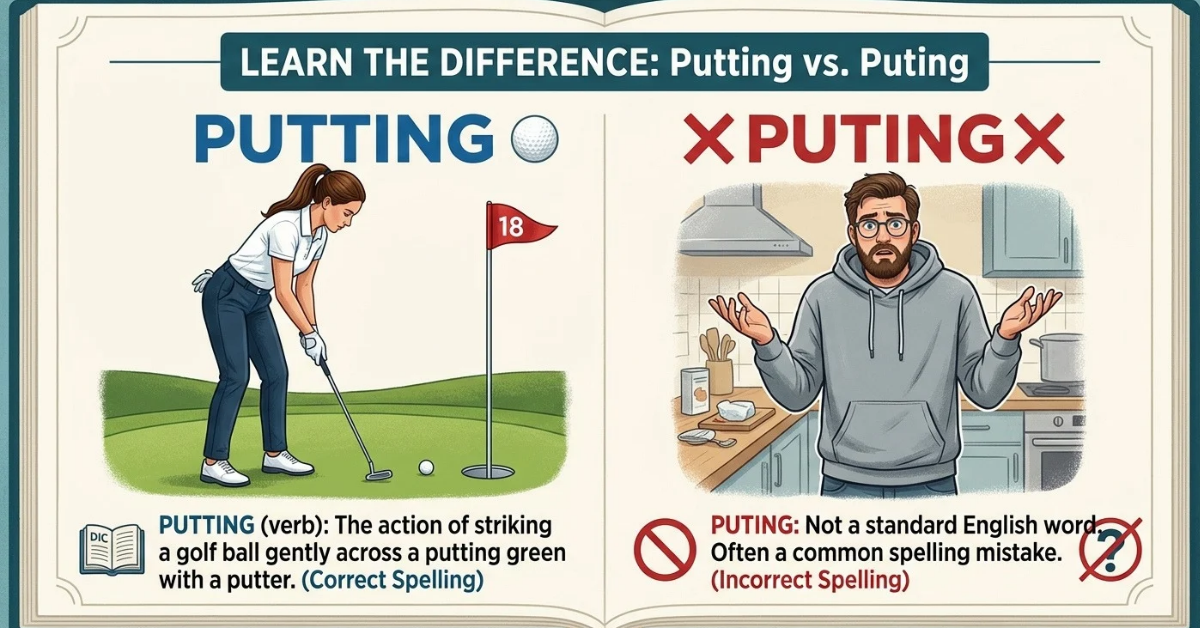
The correct spelling is putting, with two “t”s. Puting is generally a misspelling when you mean placing something somewhere, participating in an action, or referring to the golf technique. Understanding why the extra letter is necessary can help you avoid this mistake in emails, school assignments, professional writing, and everyday conversations.
In this guide, we will explore the difference between puting and putting, explain the spelling rule, and provide practical examples to make the correct form easier to remember.
Puting or Putting: Which Is Correct?
The correct spelling in standard English is putting. It is the present participle and gerund form of the verb put.
The word put has a special spelling pattern: when adding the suffix -ing, the final consonant is doubled. Therefore, the correct combination is put + ing = putting, not puting.
Here is a quick comparison:
- Putting: Correct spelling.
- Puting: Incorrect spelling in standard English when intended as the form of the verb put.
For example:
- Correct: She is putting her books on the shelf.
- Incorrect: She is puting her books on the shelf.
Although the incorrect version may look reasonable at first glance, it does not follow the standard English spelling rule.
What Does Putting Mean?
The word putting can have several meanings depending on the context. Most commonly, it describes placing something somewhere, performing an action, or making an effort.
1. Putting as Placing Something
In everyday English, putting often means moving an object to a particular place or position.
Examples include:
- He is putting his phone in his pocket.
- I am putting the groceries in the kitchen.
- She is putting the documents on the desk.
In each example, the word describes an action that is happening or being performed.
2. Putting in Golf
In golf, putting refers to using a putter to roll the ball toward the hole, usually on the putting green. It is an essential part of the game because players generally aim to complete a hole with as few strokes as possible.
For example: “His putting improved after he practiced his aim and distance control.”
This sporting meaning is another reason people search for the correct spelling of putting.
3. Putting in Expressions
The word also appears in many common English expressions.
Examples include:
- Putting in effort: Working hard to achieve something.
- Putting something off: Delaying a task or decision.
- Putting someone first: Prioritizing another person’s needs.
- Putting something into practice: Applying an idea or skill in a real situation.
For instance, “Putting in consistent effort can help you improve your writing skills.”
These expressions are widely used in both spoken and written English.
Why Is Putting Spelled With Two T’s?
The spelling of putting follows an important English grammar rule known as the final consonant doubling rule. When a one-syllable verb ends in a consonant-vowel-consonant pattern, the final consonant is usually doubled before adding -ing.
The word put follows this pattern:
- P: Consonant
- U: Vowel
- T: Consonant
When you add -ing, the final t is doubled to form putting. This rule also applies to several other common verbs. Cambridge Dictionary’s grammar guide explains this spelling pattern with examples such as sit → sitting and hop → hopping.
More Examples of the Doubling Rule
| Base verb | Correct -ing form |
|---|---|
| Put | Putting |
| Sit | Sitting |
| Run | Running |
| Get | Getting |
| Stop | Stopping |
| Swim | Swimming |
| Plan | Planning |
| Shop | Shopping |
Remember that this rule does not apply to every verb. For example, play becomes playing, and read becomes reading. Learning the pattern alongside its exceptions makes English spelling easier to understand.
Puting vs. Putting: Common Spelling Mistakes
Even people who speak English fluently can make spelling mistakes when typing quickly. The good news is that a few simple habits can help you catch them.
Mistake 1: Forgetting the Double T
The most common error is writing puting instead of putting. Since the two forms look almost identical, the missing letter can easily go unnoticed.
Incorrect: I am puting the clothes away.
Correct: I am putting the clothes away.
Mistake 2: Assuming Every Verb Follows the Same Rule
English spelling patterns vary depending on the letters at the end of a word. While put becomes putting, help becomes helping because the base verb ends in two consonants.
Compare these examples:
- Put → Putting
- Help → Helping
- Make → Making
- Sit → Sitting
Understanding these differences is more useful than trying to memorize every word separately.
Mistake 3: Overlooking Errors During Proofreading
Spell-checking tools can help identify spelling errors, but they should not replace careful proofreading. When writing something important, such as a job application, university assignment, or professional email, take a moment to review your work.
A quick spelling check can make your writing clearer and more professional.
How to Remember the Correct Spelling of Putting
If you frequently confuse puting and putting, try these simple techniques.
- Remember the base word: Start with put and add -ting to form putting.
- Look for the double consonant: The final t appears twice in the correct spelling.
- Practice with sentences: Write a few examples, such as “I am putting my bag down.”
- Compare similar words: Remember the pattern in sit → sitting and run → running.
- Proofread your writing: Pay particular attention to words ending in -ing.
Consistent practice will help you recognize the correct spelling naturally.
Frequently Asked Questions (FAQs)
1. Is it puting or putting?
Putting is the correct spelling in standard English when referring to the action of putting something somewhere. Puting is a misspelling in this context.
2. Why does putting have two T’s?
The final consonant is doubled when the suffix -ing is added to the one-syllable verb put. Therefore, put + ing becomes putting.
3. What is the meaning of putting?
Putting is the present participle or gerund form of put. It can describe placing an object, performing an action, or making an effort. In golf, it refers to rolling the ball toward the hole with a putter.
4. Is putting a real English word?
Yes. Putting is a standard English word used in everyday conversations, formal writing, and sports terminology.
5. What is the difference between put and putting?
Put is the base form of the verb, while putting is its -ing form. For example, “I put my keys on the table” describes an action in the past, while “I am putting my keys on the table” describes an action in progress.
6. Is putting spelled the same way in British and American English?
Yes. The spelling putting is the same in both British and American English. There is no regional spelling difference between these two forms.
7. What are some synonyms for putting?
Depending on the sentence, possible alternatives include placing, positioning, setting, laying, and inserting. These words are not interchangeable in every context, so choose one that fits the intended meaning.
8. How can I improve my English spelling?
Read regularly, practice common spelling patterns, use a reliable dictionary, and review your writing before submitting it. Learning how suffixes affect base words can also help you avoid frequent mistakes.
Conclusion
When deciding between puting or putting, always choose putting when you mean the -ing form of the verb put. The extra t follows the English consonant doubling rule, making the correct spelling straightforward once you understand the pattern.
Whether you are writing a school assignment, sending a professional message, or discussing golf, using the correct spelling helps your writing look polished and clear.
To strengthen your spelling skills further, explore other commonly confused English words and practice applying the rules in your everyday writing.
